





What is heat transfer printing?
Thermal transfer printing technology was developed by European printing technicians in the late 1960s. This process uses the sublimation principle of disperse dyes or inks, uses paper as a carrier, and transfers the pattern printed on paper to the paper through temperature sublimation.
Thermal transfer printing technology began to be put into production in some printing factories in the early 1970s, but most of this stage is to transfer the pattern of transfer printing paper to chemical fiber fabrics such as garments, garments, bags or cut pieces by intermittent pressing. . In the mid-1970s, transfer printing technology began to be put into continuous production like traditional printing. Due to the improvement of printing paper equipment, the quality of transfer printing base paper was correspondingly improved, and its machine printing paper production capacity was generally 2000~3000m/h.
Thermal transfer printing classification
Thermal transfer printing is usually divided into hot-melt transfer printing and sublimation-type transfer printing. Hot-melt transfer printing is often used in cotton products, but the disadvantage is that it has poor hand feel and air permeability. Sublimation transfer printing is often used for polyester transfer printing, but the disadvantage is the high cost of plate making.
The most commonly used thermal transfer printing method is the sublimation method.
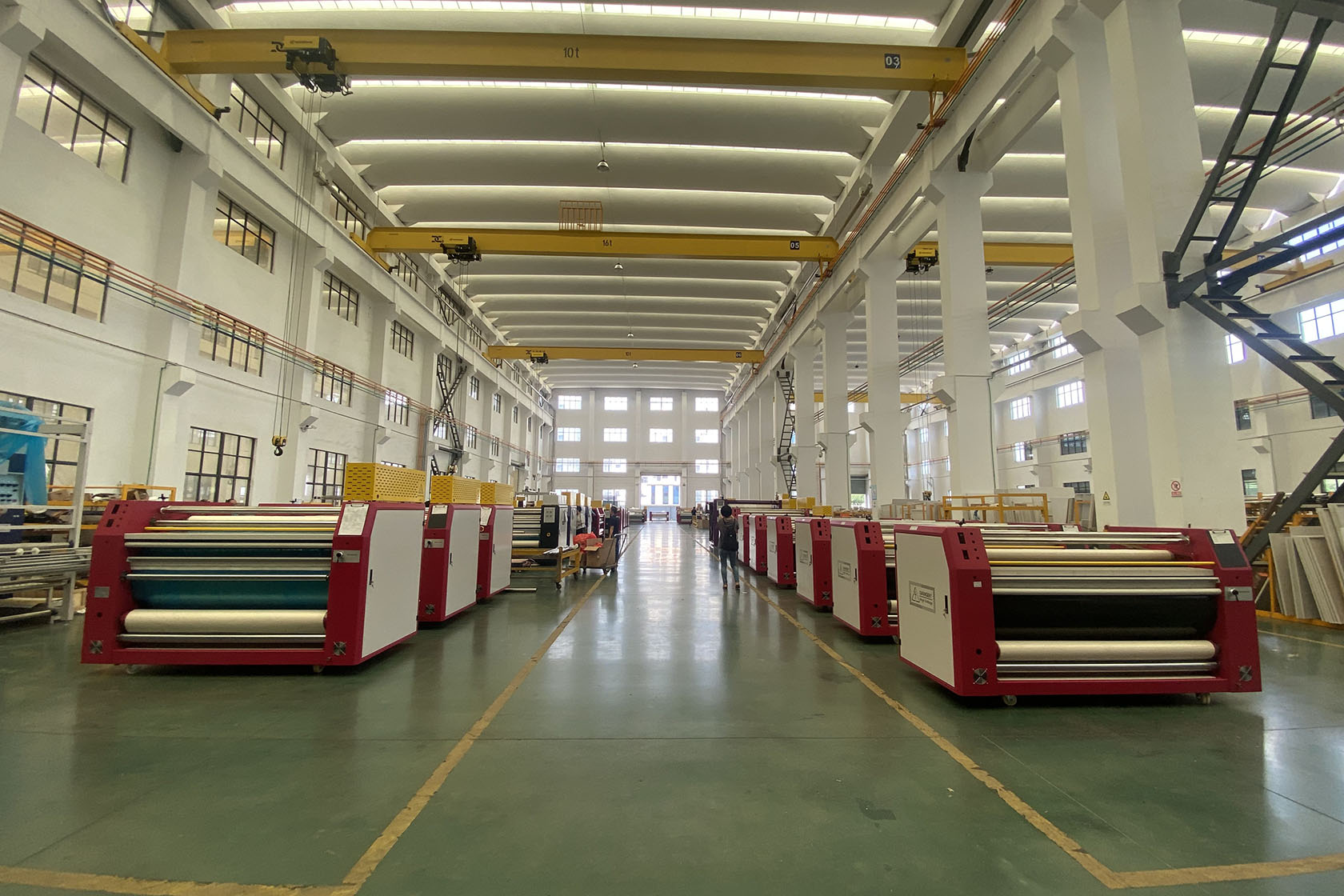
The specific process is to pass the pattern through the plate-making roller or flat screen, or it can be printed on the paper with disperse dyes or ink by a rotary screen Printing Machine. Then, the transfer printing paper printed with the pattern pattern is combined with the fabric under the adapted temperature and pressure conditions through the transfer printing machine, and the pattern pattern on the paper is instantly sublimated and transferred to the surface of the fabric through physical and chemical action, and at the same time diffuses and penetrates into the fiber. The inner layer is fixed. This is the current process of heat transfer printing on polyester fabrics.
Sublimation transfer printing can be divided into different printing methods: offset printing, gravure printing, silk screen printing, data printing.
Compared with traditional processes, thermal transfer printing has the following advantages:
Small footprint and short process flow;
Because of the sublimation and color-fixing properties of disperse dyes, the color can be completely fixed;
The post-processing process such as fixing and washing is reduced, thus eliminating the problem of sewage, and it is an environmentally friendly printing and dyeing method.
Since the liquid absorption of the dye by the transfer printing base paper is much less than that of the direct printing on the fabric, the cost is relatively reduced.
Defects caused by complex color matching and pattern matching can be found when printing decals, and the defective decals can be cut off before transferring to the fabric, so as to ensure the highest genuine rate of finished fabrics after transfer.
In transfer printing, because the base paper has very little wide penetration, the pattern of the transfer printing cloth is clearer, the layers are more distinct, and the color is more uniform. The three-dimensional effect is strong, especially in the halftone effect.